Monday, June 17, 2019

The air-conditioning system


A decade ago, the air-conditioning (A/C) system was an extra feature in a vehicle just like the heated seats, a full airbag system, the reverse camera and sensors… However, nowadays it has become a necessity because of many aspects, such as the huge increase of cars on the roads causing loads of traffic jams and the amount of jobs requiring a long time driving in the hot weather.

The A/C system consists of numerous parts that differs between automotive brands:
  • The compressor: Increases the pressure of the refrigerant in the system.
  • The A/C hoses (High and low pressure): Connect all the system’s components to create a closed loop
  • The condenser: Cools the refrigerant
  • The fans: Blow cold air through the condenser
  • The receiver dryer OR The accumulator: Removes the moister from the system
  • The thermal expansion valve OR The orifice tube: Regulates the flow of the refrigerant in order to expand it and reduce its pressure.
  • The evaporator: Absorbs the heat from the cabin to cool the refrigerant and turn it into gas (You might see ice forming on this component)
  • The blower: Blows cold air from the evaporator into the cabin
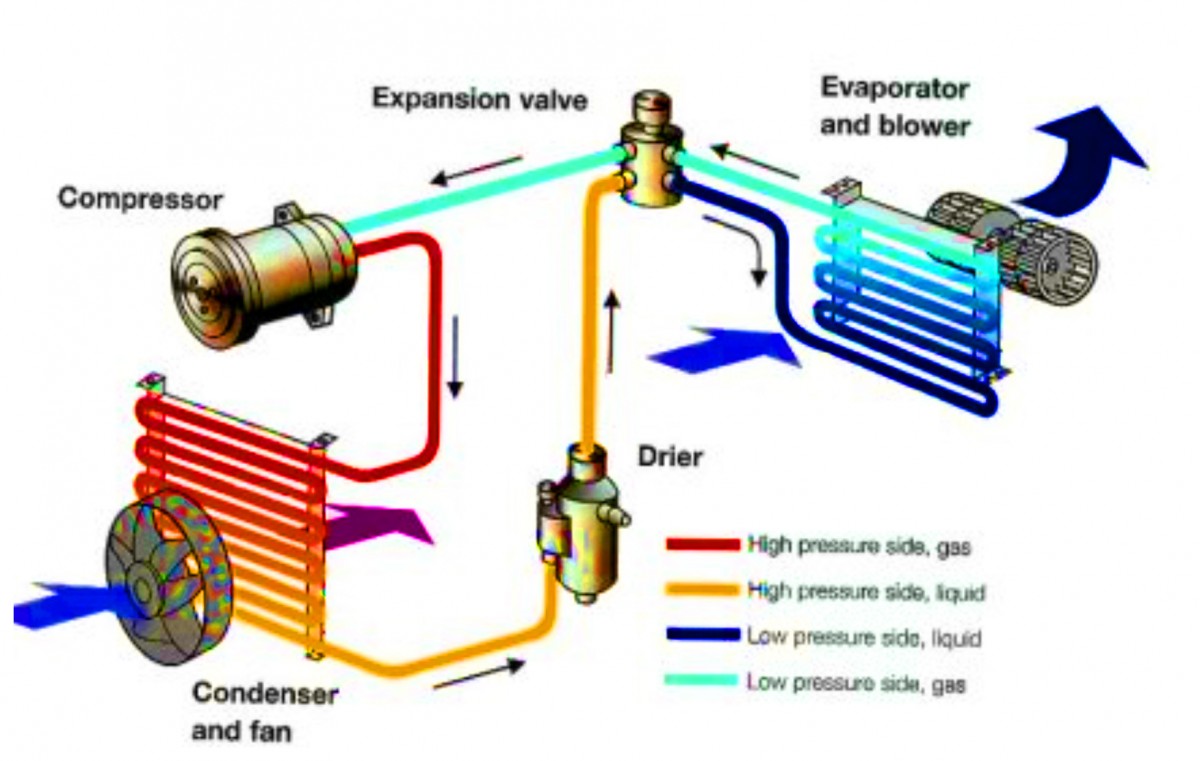
Figure 1: Air-conditioning system diagram (Did It Myself, 2019)

The system works by changing the pressure of the refrigerant gas which affects its temperature, this pressure-temperature relation is similar to a sprayer can getting colder when spraying for a long period of time. According to Guy-Loussac’s law, pressure and temperature are proportional, hence a low-pressure gas has a low temperature (cold) whereas high pressure gas inflicts a high temperature (hot).

The air coming out of the vents has always the same temperature. The temperature set on the A/C panel (Marked in blue in figure 2) is the desired cabin temperature. Consequently, once the actual temperature of the vehicle’s cabin reaches the desired one, the A/C compressor shuts off.
The recirculation loop button (Indicated in red in figure 2)assure a closed loop air system by preventing any outer air (Mostly hot) coming into the cabin which allows the air-conditioning system to transform the hot air inside your cabin to cold air.
The A/C button switch (Circled in yellow in figure 2) turns on and off the compressor manually.

Figure 2: Air-conditioning panel

Although the manufacturers are developing more efficient A/C systems, it remains the most fuel consuming feature in a vehicle when turned on (an increase of up to 20%), and that’s due to the fact that the compressor’s pulley is rotated by the drive belt that is connected to the crankshaft pulley which adds load on the engine.

Nevertheless, it is possible to reduce this increase of fuel consumption, here some tips:
  • Adjust your thermostat settings to a comfortable temperature rather than a cold one.
  • Always use re-circulation to cool only the air inside the car
  • Open the windows without any A/C at start-up (For few minutes)
  • Park your vehicle in the shade or use window shades to reduce the heat inside the car


   References:
  • Did It Myself. (2019). Recharging Car Air Conditioning - Did It Myself. [online] Available at: https://did-it-myself.com/recharging-car-air-conditioning/ 
  • Completely Firestone. (2019). All About Your Car's A/C System | Firestone Complete Auto Care. [online] Available at: https://blog.firestonecompleteautocare.com/maintenance/everything-you-need-to-know-about-your-cars-ac/
  • Nrcan.gc.ca. (2019). Vehicle air conditioning | Natural Resources Canada. [online] Available at: https://www.nrcan.gc.ca/energy/efficiency/energy-efficiency-transportation-and-alternative-fuels/choosing-right-vehicle/tips-buying-fuel-efficient-vehicle/factors-affect-fuel-efficiency/vehicle-air-conditioning/21030 

Sunday, May 19, 2019

Who Owns Who In The Automotive Industry


While buying a new part for your vehicle, you might notice that it has multiple car brand logos engraved on it. Or when checking the structure of many systems (Engine, transmission, suspension…) a big similarity is noticed in many vehicles.

This resemblance is due to the fact that numerous brands are owned by one parental brand.
Hence, if you are having a hard time finding the original part for your vehicle, it would be helpful to check the shops that have parts for brands that share the same parent brand of your car. (Checking the manufacturing year of your car and the relations between brands at this year is important, due to the changes that occur during the years.)
However, it is advised to buy the original part that has the same part number as your car, but a plan B never hurts right?

The table below shows various vehicle brands and their respective parent brand in year 2019:


Parent Brand
Brands
Volkswagen
Audi; Bugatti; Bentley; Lamborghini; Porsche; Seat; Skoda; Volkswagen
BMW
BMW; Mini; Rolls Royce
Hyundai
Hyundai; Kia; Genesis
Daimler
Mercedes; Maybach; Smart
Fiat Chrysler Automobiles (FCA)
Alfa Romeo; Abarth; Chrysler; Dodge; Fiat; Jeep; Lancia; Maserati; RAM
Honda
Acura
Toyota
Daihatsu; Lexus; Toyota
General Motors (GM)
Buick; Cadillac; Chevrolet; GMC; Holden; Opel; Vauxhall
Ford
Ford; Lincoln
Renault-Nissan
Dacia; Datsun; Infinity; LADA; Mitsubishi*1 ; Nissan ; Renault ; Samsung
PSA Peugeot Citroen
Citroen ; DS Automobile ; Peugeot
TATA Motors
Daewoo ; Jaguar ; Land Rover ; TATA
Geely
Geely; Volvo
INDEPENDENT BRANDS
Aston Martin; Mazda; McLaren; Saab; Subaru; Suzuki ; Tesla

*Some resources consider Mitsubishi as an independent brand because Renault-Nissan owns approximately 34% of Mitsubishi only.

Sunday, March 31, 2019

“Bel tanke” (Fuel consumption test) :


Nowadays, minimizing the fuel consumption is a common goal for all automotive manufacturers, as well as a key feature for any person searching to buy a car. Moreover, a sudden increase in gasoline consumption is a nightmare for any car owner.
In Lebanon, a famous term exists to identify the distance travelled using 20 liters of gasoline known as ‘Bel tanke’.


Many aspects influence the fuel consumption of a vehicle. The outside factors such as the outside temperature, pressure (related to the altitude) and the road characteristics (such as angle of the slope, shape…). Inner factors depend on the driver’s technique (Gear changes for example), and the weight of the passengers and their goods.

Therefore, if you are feeling that your vehicle is consuming fuel more than it should or you are just interested in knowing the amount of gasoline used ‘Bel tanke’ of your car, you can always confirm your doubts by stabilizing as much as possible the aforementioned aspects and by following those simple steps:
  1. Go to a fuel station and fully fill your fuel tank.
  2. Before leaving the station, reset your trip meter (Check your owner’s manual or check online for ‘ Trip reset’ followed by the brand, sub brand and manufacturing year of your vehicle).
  3. Drive your car for a specified distance of your choice.Go to the same fuel station and fully fill your fuel tank again. Note the quantity of gasoline bought and the amount displayed by your Trip meter before leaving.
  4. Now divide the distance noted by the gasoline quantity to get the distance travelled per 1 (unit) of gasoline.
  5. Finally, a ‘Tanke’ is 20L of gasoline as aforementioned, therefore multiply the last result by 20 to get how much your vehicle is consuming per ‘Tanke’.
N.B: Pay attention to the units. The commonly used ‘Bel tanke’ is usually in Kilometers and Liters.

Saturday, March 23, 2019

Motor oil specifications and types


Everyone has heard about motor oil specifications (such as 0W-30, 10W-40, 20W-50... etc.) and motor oil types (synthetic oil, conventional oil… etc.). However, few really understand the meaning behind those terms and the suitable motor oil for their vehicle.


Motor oil specifications:

The motor oil specifications identify the viscosity of the oil and follow the universal form “xx W – yy”.
  •  The term ‘W’ stands for winter.
  •  The ‘xx’ indicates the viscosity of the oil when the engine is starting in cold weather (Around -17 ˚C). A lower viscosity triggers a smoother start-up in cold areas and provides an easier task for the oil pump.
  •  The ‘yy’ refers to the viscosity of the oil when the engine is in ideal working temperatures (Around 100 ˚C). A high viscosity in hot conditions results in a thicker oil that is suitable for hot countries and older engines.
Additionally monograde oils exist (such as SAE 30, SAE 40…) but are no longer used in modern automotive engines.
The table below indicates the suitable oil grades for different temperature ranges:

Oil Grades
Temperature ranges ( in ˚C)
0 W - 30
-35 à 35
5 W - 30
-25 à 35
10 W - 30
-20 à 35
10 W - 40
-20 à 40
15 W - 40
-10 à 40
20 W - 50
0 à 50

Motor oil types:

Motor oil types differ in cost, additives that they contain, and usage from one and another. Four general types of oil exist:

  • Full synthetic motor oil:
    This type of oil has 0 impurities due to the extra chemical engineered process that has gone through. Therefore, it is the best for people seeking to achieve the engine’s peak performance. Additionally, it contains many additives that protect the engine against oxidation, high and low temperatures…However, it costs up to four times (4x) the price of a conventional oil.
  • Conventional oil:
    The most commonly used type of oil. It has less additives and presents less protection than the other types. However, it does its job to lubricate the engine and it is much cheaper than the other types.
  • Synthetic blend oil:
    This blended oil is a mix of both conventional and synthetic oil in addition to some additives. It is becoming extremely popular nowadays because of the similarity in aspects and protections to the synthetic oil while costing much less.
  • High mileage motor oil:
    As the name shows, it is made for vehicles with high-mileage (more than 75000 Miles), especially modern cars because of the additives it contains which help reduce and protect from leakage, corrosion and oil burn-off. Money wise, it costs almost the same as the synthetic blend oil.

Conclusion:

Therefore, to pick the suitable oil grade and type for your vehicle:
  •  If the car is produced for your country/area, check the owner’s manual.
  • If your vehicle is imported, seek assistance from a local expert.
  • Check the temperature’s range in the upcoming 5-6 months especially if you are in an area that the temperature flactuate significantly.


Monday, August 10, 2015

Driving safely in the fog

Fog is a difficult weather condition to drive in, and should not be taken lightly. It is a visible mass consisting of cloud water droplets or ice crystals suspended in the air at or near the Earth's surface which affects human visibility.

To drive safely in the fog, follow the below tips:
  1. Check the density of the fog before taking the car (fog appears mostly in the early morning or towards the evening). It is better not to drive in the fog if it is very dense.
  2. Allow more distance between vehicles on the road.
  3. Turn the headlights on. 
  4. Turn the Fog lights on if available.
  5. Use the hazard warning button to be more visible to others.
  6. Don't drift. Make sure you follow the right edge of the road so you don't accidentally drift toward the middle of the road.
  7. Pull over to the side of the road if you have no visibility. 
  8. You can ask passengers with you in the car to keep an eye on the road to make sure there are no obstacles on the road.

Tuesday, January 6, 2015

Driving in a Snowstorm

1) Keep your vehicle in 1st or 2nd gear on snow or ice:
A lower gear not only keeps your car moving slower, it gives the tires more power and more traction which is vitally needed on slick roads.

2) Put your vehicle in a lower gear when turning:

Because of the weight shift on a turn it is much easier to lose control (even in dry weather) in the middle of a turn. It is very easy to skid even in 2nd gear on icy roads when turning, 1st gear is safest.


3) Use the gas pedal and brake pedal as gently as possible at all times on snow and ice:
Any pressure on either pedal causes the weight of the vehicle to shift. (brake pressure sends weight to the front, gas sends it to the rear).  This can cause a dangerous loss of balance and control on ice. Therefore use very little pressure on either. This also means brake very early.


4) Push the gear in neutral to stop at red lights and stop signs:
This is contrary to the teaching of safe driving practices but icy conditions require different driving than in dry or wet but non-freezing conditions.
Snow and ice are the only time I would suggest using neutral to help brake, and once you are stopped, immediately put the gear in 1st or 2nd again.
Neutral disengages the engine from the wheels so the engine isn't moving the car forward. This brings a car to a stop much quicker on ice.

5) If you start to skid push the gear in neutral:

I was on my way to a student one morning when heavy snow started falling half way to her house. Although I was driving slow and careful in 2nd gear, as I made a left turn my tires lost traction and I started skidding slowly toward a stopped car to my left headed the opposite direction.
I remembered what my boss told me about using neutral to come out of a skid. As soon as I put my car in neutral my car immediately stopped just about three feet from the other vehicle. This winter driving tip saved me from a collision.

6) Stay on the roads most traveled:

This is pretty much common sense. There are several reasons using busier roads in snow is a good winter driving tip.
More traveled roads will be partially cleared by other traffic.
There is a higher chance the city has brought snow plows and deicers on busier streets.
If you do get stuck on the ice there is a better chance of finding help on a road with more traffic.


7) Don't trust Chains on very steep hills with ice, even with a four wheel drive vehicle:

In South East Portland in 2008 many drivers with Jeeps and other 4WD vehicles believed because they had chains on their tires, their vehicles could safely get down the steep hill of Johnson Creek Blvd. from Mount Scott.
It was laughable to watch the clips on the news of many SUVS' with chains sliding into parked cars on the hill because there just wasn't the traction the drivers thought there would be.

!!! Don't drive on Snow and ice unless you absolutely need to !!!

Even straight, flat,  frozen, wet roads can be unpredictable.  The drivers on them are unpredictable as well. The best of drivers can easily lose control on ice with one slight error with the steering or the pedals.
Wait until the roads unthaw before driving on them if you can. It will be safer and a lot less stressful behind the wheel if you do.

Source: http://www.drivingtips.org/winter-driving-tips.html 


Other blog posts that will help you make it home safely: